
The Trauma of Childbirth
by Savannah Flanagan
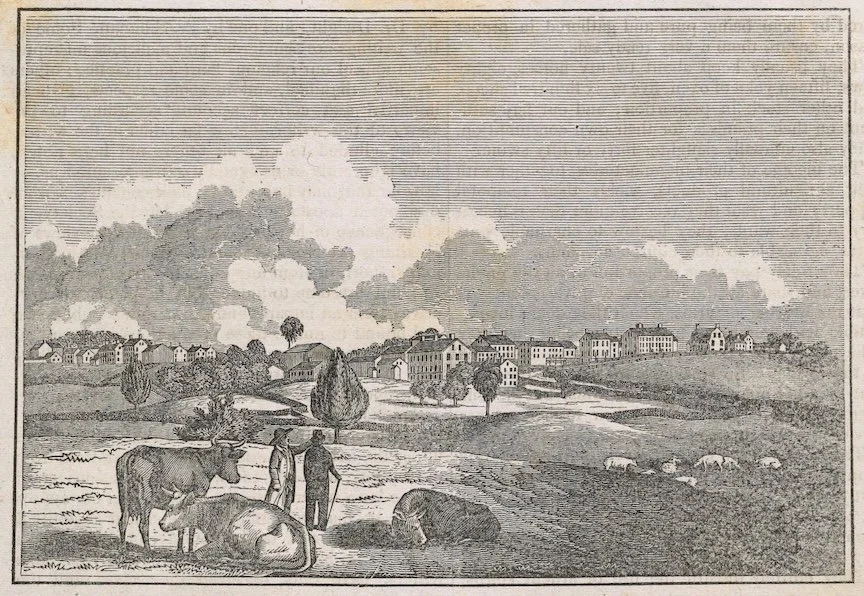
“The Village of the United Society of Shakers, in Canterbury, N. H.,” American Magazine of Useful and Entertaining Knowledge 2 (November, 1835), p. 133.
It’s not often that those of us who study religious women, intentional communities, or religious history in general have the opportunity to see a major film about our research interests. I was incredibly excited to see The Testament of Ann Lee, and the film did not disappoint. However, Mona Fastvold’s vision surprised me in many ways. While the visceral worship and repeated violence against Ann Lee illuminates important parts of her story, I was shocked by the depiction of women’s lives and experiences. Fastvold captured the brutality of childbirth and postpartum suffering, and acknowledged the appeal of a communal and celibate lifestyle for women typically stuck in a cycle of reproduction.
During the first act of the film, set in Manchester, we witness Ann's early life, including her marriage to Abraham and her subsequent experiences with childbirth. She had four children, but none lived past infancy. While the historical record does not provide specific information about the condition of each birth or the cause of death for the children, the film chooses to explore the different possibilities. In each small scene, we witness a historically accurate depiction of birthing positions (from supported squatting to hand and knees) and the turmoil Ann experiences. We watch her experiences in sequence, reflecting the quick and repeating nature of childbearing in the eighteenth century: She is unable to breast-feed her first child, has a stillborn, begins to bleed out, and eventually experiences mental decline. Her spiritual enlightenment to the practice of celibacy not only responds to a lifelong disdain for sex, but also to repeated pain and suffering from childbirth. Divinely ordered celibacy allowed women to escape cycles of sex and childbearing in a world where women had no legal right to refuse their husbands sex.
The film continues to explore the themes of maternal suffering and the appeal of Shaker celibacy once they are established in Niskayuna. We witness those who are introduced to the Shaker faith and the conversion efforts of Ann and her brother William. In one scene, we hear the confession of a young woman, who admits that after having her baby, she suffered mentally. Unable to withstand the incessant needs of her child, she admits that she was tempted to throw the infant in the well. While it is a jarring confession, Ann responds with understanding and offers community. This young woman represents the daily struggles of mothers who had no support, and perhaps also suffered from what we would now call post-partum depression. From this example, we see how Shakerism could be appealing to some women, as it provides community, understanding, and a way out of the reproduction cycle.
While celibacy may seem an extreme practice for eighteenth-century Protestant women, the realities of women’s maternal experiences make it seem less radical and perhaps even more appealing. Films such as this, that highlight experiences of religious women, can complicate common understandings of religiosity as well as womanhood throughout history. To modern sensibilities, Shakerism’s communal living and practice of celibacy can be confounding, but in the context of early modern women’s lives, we can imagine how it might have been rather appealing.
Savannah Flanagan is a PhD Candidate in the History Department at Baylor University.