Outsider Hagiographies
by Ashley Douglas
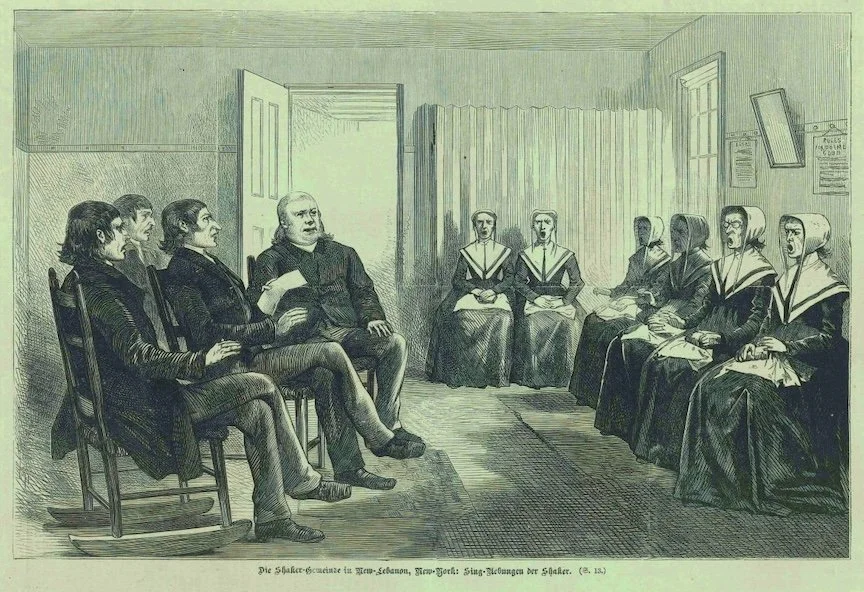
George Gilbert. “Shakers Worshiping. (exercise), Atkinson’s Casket, or Gems of Literature, Wit and Sentiment 6 (February, 1831), inserted facing page 73.
As a scholar of Catholicism with research interests in hagiography, I was captivated by Mona Fastvold’s The Testament of Ann Lee, not only as an example of hagiography outside my tradition of study, but as a hagiography done “from the outside” of the subject tradition. In this short reflection, I would like to consider how “outsider hagiographies” work to promote an ideal via a selective retelling of an exemplar’s life as a mode of dialogue with religious powers and religious people.
As the narrator told us about Ann Lee speaking in multiple languages in court, and as we watched her levitate slightly above the floor of her prison cell in the throes of ecstatic prayer, I saw in the film several marks of a typical medieval or early modern Catholic hagiography. Yet, this was not a Catholic hagiography, nor was this written or performed by a member of Ann Lee’s religious tradition. What drove writer and director Mona Fastvold to retell a version of her life—notably preserving her mystical qualities—even when her positioning might tempt us to consider her an “outsider”?
Fastvold stated in a Q&A session with the American Film Institute, “I am drawn to people who attempt impossible things. And I think that what Ann Lee, her idea of female leadership, maternal leadership, this idea of utopia, is this impossible thing that really spoke to me as an artist as well. Why do we try and make these things?” In another interview, Fastvold elaborated on Ann Lee’s leadership, saying that she wanted to tell Lee’s story now because it spoke to the present moment: “We need to think about leadership in a different way. Leaders around the world are leading from a place of fear and intimidation, which is the opposite of Ann Lee. She led from a place of nurturing, mothering and equality.” To TIME, she said she was drawn to Ann Lee for building a community in which she could devote herself to work, but not for “not for personal gain or money.” While Fastvold might be an outsider in the sense that she is not a Shaker, she is an insider in the sense that she sees parts of herself in Ann Lee and shares, or at least admires, some aspects of her vision.
I propose that Fastvold’s TheTestament of Ann Lee may belong to an underexplored strain of hagiography: one in which a religious “outsider” retells the story of a religious figure for the purpose of promoting, or at least exploring, an ideal. Since I saw the film, I have been looking for more examples of religious “outsiders” utilizing religion for some clear purpose, be it storytelling or political debates. For Fastvold, however, the life of Ann Lee is about the willingness to attempt the impossible, the concept of utopia, the idea of maternal leadership and equality, and labor for labor’s sake rather than gain. Perhaps, then, this film represents something of an awakening to religion’s power: to tell a story, to explore an idea, to make a point, to cast an ideal about how we should live with one another. Indeed, if we understand as scholars that religion is not going anywhere, even in an increasingly unaffiliated America, and that religion will continue to play a role in our broader political and social lives whether or not we are personally engaged with any practices or traditions, then I hope that this sort of “outsider” hagiography is something that we will see more often as a kind of dialogue between religious “outsiders” and “insiders.”
Ashley Douglas is a PhD student in the Religion Department at Princeton University.