A Cult Movie
by David Reed Hall
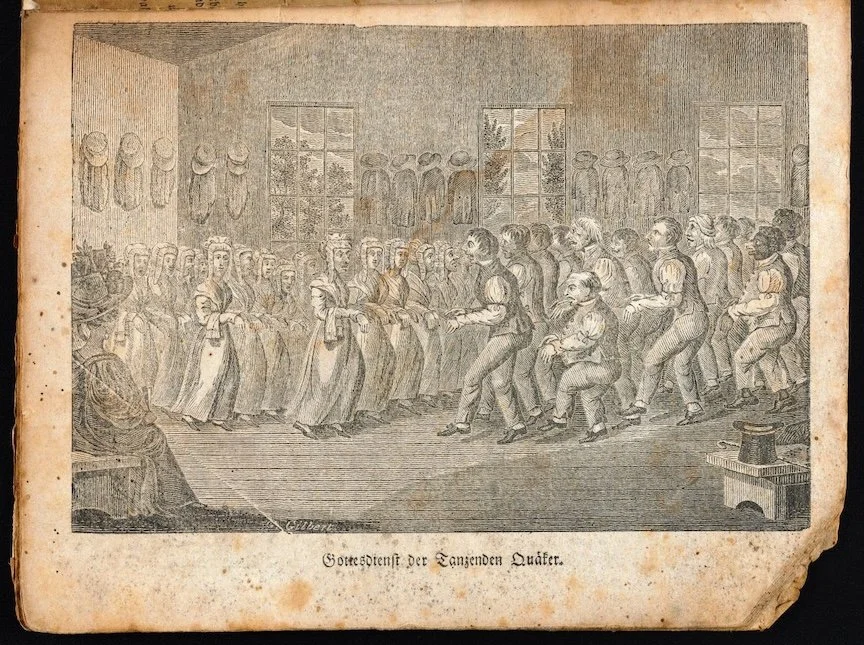
George Gilbert. “Gottesdienst der Tanzenden Quaker,” Amerikanischer Stadt und Land Kalendar auf 1831ste Jahr Christi. [Philadelphia: Conrad Zentler, 1830).
About a week after I had watched The Testament of Ann Lee (2025), I overheard an undergraduate student tell another that the movie was about how “Ann Lee’s life sucked” and then she founded a cult. Having read the work of J. Gordon Melton, David Bromley, and Eileen Barker, that student’s use of “cult” immediately put me on the defensive. Ann Lee did establish a “new religious movement,” and there may be scenes of her suffering, but I thought that surely there was more to the movie than suffering and cults. I wanted to believe that the student’s view could be “corrected” with the right amount of “religious literacy,” but as I sat with those comments, I realized their use of “cult” highlighted something real within the movie itself.
In the student’s description of The Testament of Ann Lee as a movie about a cult, I believe they were reaching for language to describe what they found uncomfortable with the Shakers. As a “new” religious movement in the eighteenth century, today’s audiences are already skeptical about Ann Lee’s sincerity, despite the sympathy that her suffering might engender. In my own viewing, I was put off by how easily the early Shakers accepted Ann Lee’s visions in the movie, and the scene accompanying the song “I Love Mother” gave an uncomfortable sense of collective devotion to Ann Lee. In these instances, the Shakers may appear similar to recent “cult” archetypes for this student, where followers living in a commune appear devoted to a charismatic leader. Likewise, the Shakers’ ecstatic worship, emotional public confession, and choreographed dances may appear bizarre to today’s viewers who lack analogous frames of reference beyond a loose resemblance to charismatic Christianity. This existed in tension with Lee’s pain during childbirth, imprisonment, and experience of mob violence. Her suffering lent credence to her sincerity and made her rejection of sex legible to the audience. Since cult documentaries remain popular, “cult” was a critical framework for these students to unpack the religious structures within The Testament of Ann Lee so they could express their discomfort. At the same time, this framing was not the movie’s intention, and the use of “cult” unintentionally reduced Lee’s sympathetic suffering into a form of pathological religion.
The Testament of Ann Lee may be about how Ann Lee suffered and founded a new religious movement, but it also contained more than this student could describe through “cult.” This undescribed factor was especially prevalent in the song “Beautiful Treasures,” which played during Ann Lee’s funeral. Here the Shakers assembled for another choreographed dance, but the lyrics emphasized the “beautiful treasures” within Ann Lee’s teachings in a way that showcased the deeper spiritual life that they enjoyed within her movement. Of course, the reasons why converts joined and stayed with the Shakers were manifold, but they happened both because and in spite of the same factors that made this student uncomfortable. In this undescribed dimension, The Testament of Ann Lee’s complexity provides a helpful tool for exploring the tension within our own analytical frameworks between critique and celebration alongside the terms students use to describe religion.
David Reed Hall is a PhD student in the Religion Department at Princeton University.