Defying Accountability: Wicked, For Good, and the Afterlives of Oz
August 2026
This is the second conversation from the Race, Film, and the Moral Imaginary spring series. Here we talk about Wicked: Part 1 and its sequel Wicked: For Good to explore themes of prejudice, identity, and belonging. Based on the beloved Broadway musical and Gregory Maguire's 1995 novel, the films retell the story of Oz through the unlikely friendship of Elphaba and Glinda — the women who will become the Wicked Witch of the West and Glinda the Good. Directed by Jon M. Chu and starring Cynthia Erivo and Ariana Grande, the films ask us to reconsider who gets to be “good,” who is deemed “wicked,” and what it costs everyone when that distinction is made while reified on and against certain bodies.
Samah Choudhury: Wicked seems to join a pantheon of media that inverts the premise of familiar narratives: the Joker, the Boys, Maleficient, Cruella, I, Tonya (the latter two even share the same director). The question of “what if the baddie was actually a baddie?” has been asked so often lately that it would have been easy for Wicked to get lost in the crowd. If ticket sales and merch and online discourse are still a barometer of interest, however, then it’s clear that we the audience have not exhausted rooting for the anti-hero! People really like exploring moral uncertainties, and what I loved best about Wicked is that it delivered on those wrought complexities without the same level of darkness and grit that often accompanies the genre. In fact, Wicked is an absolute romp, visually and aurally delightful in such a way that functions as its own unique commentary. Watching the first film and letting myself to feel the glee it inspired, the pedantic side of my brain kept thinking: wow, this is also so teachable. How can we be ethical people who pursue things like beauty and joy and justice when so much of the world is wanton, corrupt, and unjust? The friendship between two women, Elphaba and Glinda, set in an enchanted land still found them preoccupied by social capital, insecurities, dreams, guilt, and a budding sense of collective rights and wrongs. It lends itself to a sensitive exploration of morality that, sorry, the blood/guts/rancor of comic book villains simply could never.
Mihee Kim-Kort: I remember when I first read the book Wicked a few years after it came out in 1995. I was immediately drawn into the friendship of the two as the backdrop to the Wizard of Oz. There’s so much that’s simply relatable and I was also especially taken with the reversal: what appears good is not always necessarily so, and what appears bad or “wicked” is often a result of systemic prejudices and discrimination. It’s the question of how much of the way we view people is shaped by structures and categorization based on (arbitrary?) value systems? The movie undoes and opens up real-world interpersonal relationships and larger social, political, cultural issues that we often may think are clear-cut. Wicked did not disappoint in bringing these themes to life. For one, it offers a compelling commentary on these social structures, but specifically on race through its depiction of the green-skinned Elphaba, who faces discrimination and societal rejection, mirroring real-world racial biases. Her story reflects the experience of being othered, raising questions about how prejudice and inclusion circulate via certain bodies.
Amey Victoria: Oh, I really hope someone is teaching the book alongside the play and movie! While the book is different on a number of levels (to especially include the role of religion and the violences in the worldbuilding of Munchkinland and of greater Oz), I am taken by how they nuance and flatten the process of “othering.”. I suppose that flipping the perspective of The Wizard of Oz narrative is entirely the point, but it’s as if the entire discussion is working against binaries and reinforcing them at the same time. In several of my classes I teach The Color Purple across multiple modalities: the novel itself, the very controversial original movie adaptation from 1985, the Broadway play, and then again, the movie reprisal from 2023. The reference comes to mind for several reasons, not least of which is Cynthia Erivo’s incredible portrayal of Celie in the Broadway musical, and the haunting addition of her final solo, “I’m Here.” But I’m stunned by what gets communicated differently in film, and the way Erivo can so melodically evoke emotions from the depth of her soul, particularly with characters who embody the deep griefs and laments of this world alongside their own unspeakable joy. Watching a Black woman with microbraids narrate this story in green was no easy feat–many of the plays on racialization, exclusion, and villainization would have felt more close to home than I would have chosen to watch, had I not been a fan of the musical for years. But there was certainly something different, almost visceral, watching Erivo against Grande in the first act. And it truly is Elphaba’s voice that incites our resistance and solidarity as boundless, and, I suppose, retaining some sort of capacity for freedom.
SC: You’ve named something I didn’t recognize myself, AVA. The world—and we—have changed a lot since Wicked was published as a book and even when it premiered on Broadway in 2003 (the thick of the War on Terror). Growing into that world, the one that we inherited, and then living through everything that followed in the so-called American Century has meant that, like you, my patience for pop culture pieces that don’t reckon seriously with the violences of that world has waned. And you’re absolutely right, the Wicked films don’t ever come out and name the role of religion, blood, fire, and death that it must have taken to build the Oz we see, where animals labor and disappear behind a city that gleams of emeralds. Nostalgia is a real propellant for me in this case, but I’m ultimately glad for it: that steeled version of me would have otherwise missed the worldbuilding that Erivo and Grande engage in through their embodied performances. Here be a story about love, justice, and friendship, sure—but like Mihee said, this is just as much a story about racial being and becoming.
MKK: The film itself has multiple modalities: the visual backdrop, dance, musical, orated, even just the vibe and affect it is trying to give off.
SC: The primary vehicle for this complex storytelling is the music and lyrics by Stephen Schwartz. It’s what Erivo and Grande are able to do with that source material, however, that allows this story to land. Let me dig into the opening scene a bit: the movie launches with a no-holds-barred, orchestral storm accompanied by a sweeping overview of Elphaba’s fortress, the yellow brick road, the Emerald City, and eventually, a town’s square in Munchkinland right after the events of the 1939 film The Wizard of Oz. “The Wicked Witch of the West is dead!” announces Ariana Grande’s Glinda. “Isn’t it nice to know/ that good will conquer evil?/ The truth we all believe'll/ by and by/ outlive a lie/ for you and -” The Munchkins are so joyous they cut her off: “No one mourns the wicked,” they proclaim.
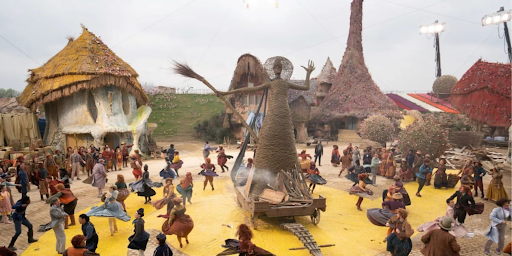
Elphaba’s effigy burns in the town square as Munchkins mob—dance and sing in celebration. https://filmcurator.medium.com/no-one-mourns-the-wicked-05945089ab78
It’s clear, though, that Glinda is in her feelings. The lyrics of this song read simultaneously as a dutiful civil servant’s speech and a woman picking at the scar tissue of her past. “No one cries they won’t return/ No one lays a lily on their grave,” the Munchkins sing. Glinda joins in, reassuring them that “Goodness knows the wicked’s lives are lonely/ Goodness knows the wicked cry alone/ Nothing grows for the wicked/ They reap only what they’ve sown.” Is she really singing about Elphaba, the heretofore Wicked Witch of the West? Grande’s delivery here is so key: her voice teeters slightly, trying to land between the official, hardened assessment of Oz’s public enemy no. 1 and then—just as quickly—a rueful self-reflection. “Woe to those/ Who spurn what goodnesses they are shown.” I love this part. The duality of (wo)man, on the verge of realization but not quite yet.
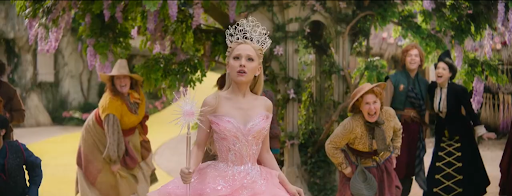
The townspeople look at the effigy with glee while Grande’s Glinda betrays a moment of grief. (Screenshot from film)
AVA: It's so true, how deeply the Munchkins are socialized and manipulated by the narration of the “other” as evil, and how we as viewers are drawn into that same act of othering as we watch; and how grief becomes the context for Glinda (and, implicated as we are, for us) to finally revisit, remember, and re-narrativize how she has participated in propping up the entire edifice.
SC: Yes! Schwartz’s work is so masterful here —the words are descriptive while the score and the mood are prescriptive. The wordsmithery of it all is charming on its own, of course, and you can always go back and see why (and really, I hope readers unfamiliar with the highwire lyrics of Wicked do that). But in the moment—amidst the singing, dancing, and the towering effigy of her best friend ablaze—Glinda’s remorse is what shines. My five-year-old watched this number glued to the celebratory spectacle, only to turn to me afterwards and ask, “But why was she so sad?” The truth, it turns out, will always seep through (that is, if you’re looking for it).
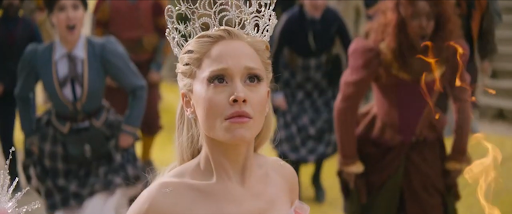
Even as she sings in celebration of the burning of Elphaba in effigy, Glinda looks remorseful while trying to remain publicly resolute. (Screenshot from film)
MKK: The affect and emotion throughout the movie was stunning, and it felt grounding in a way. I felt a deep grief in both Elphaba and yes, for sure in Glinda, despite her sunshine and bubbliness. And it came through in so many ways, and not only in those quiet moments that focused on the expression of their faces or their conversations. It was in the movement, too. Although I have zero dance background I was particularly taken with the choreography in Wicked which enhanced the narrative by visually reinforcing these themes, with group numbers often showing Elphaba’s isolation or opposition from the ensemble. There was something about the sharply synchronized movements, like these dances had their own gravitational pull versus Elphaba’s more independent, defiant gestures that underscored her outsider status. For me, this interplay between storytelling and dance added depth to the show’s exploration of race, power, and belonging.
SC: This is apparent across the film, but seems most prominent in “Dancing Through Life” and the scene in the Ozdust Ballroom. The latter actually has no musical accompaniment at all, just the sounds of whispers, taunts, and jeers as Elphaba steps onto the middle of the dance floor by herself.
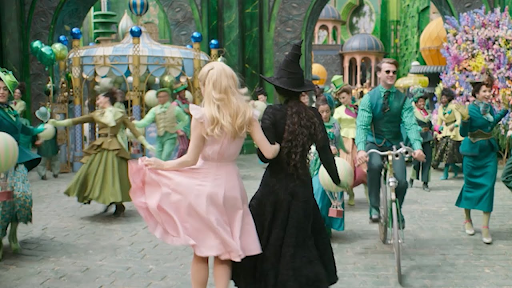
The sight of Glinda and Elphaba dancing arm and arm frames both the connection and conflict within their relationship. https://images.app.goo.gl/CZ2gDkHv7xBLod8d6
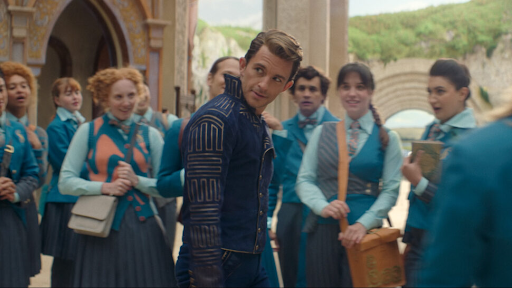
Fiyero Tigelaar looks coolly at his classmates, but we see the conflict here, too. https://images.app.goo.gl/6RGdjtKxoGzKCGoy7
MKK: Themes of exclusion and conformity were especially poignant for me, particularly in again how characters physically interacted with Elphaba. For example, in “Dancing Through Life,” the choreography highlighted an obvious and blatant social hierarchy as Glinda and the other students move fluidly and in sync, embodying privilege and ease, while Elphaba’s movements were more rigid and isolated, emphasizing her marginalized position and her outsider status, but it was as though she were trapped. This contrast deepened in “One Short Day,” when she and Glinda first entered the Emerald City. The ensemble moves in precise, mechanical unison, creating both a fascinating but strangely mind-numbing sense of order, and once more, exclusivity. As Elphaba excitedly tries to take it all in, again her movements are less controlled—she reaches out, steps forward eagerly, but is often a beat behind or slightly out of sync with the ensemble.
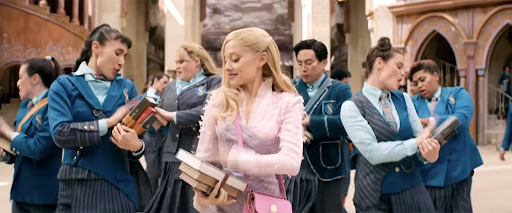
Fiyero Tigelaar looks coolly at his classmates, but we see the conflict here, too. https://images.app.goo.gl/6RGdjtKxoGzKCGoy7
AVA: I completely agree, Mihee. The calculated, sharp and angled synchronicity of Glinda’s movements (and her all-enchanted cohort) in the smug “Loathing,” feels incredibly forced, so mechanical as to even be painful, rigid, and altogether absent of imagination. It’s meant to be juxtaposed, of course, to the paced opening of “Dancing Through Life,” where Fiyero is the catalyst for everyone to at least attempt to loosen up. But it’s as if the dancing lacks connection or soul—I mean, it’s the animals playing underground that carry the heartbeat of jazz improvisation in the Ozdust Ballroom. I felt like it added to the overall staging of Elphaba’s own unseen possibilities. It’s perhaps why I took so much delight in the moments of Elphaba’s movements—she can’t get Glinda’s “toss toss” quite right, and yet, she seems so much more free.
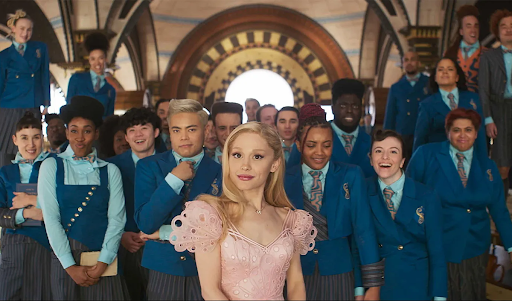
Glinda’s posture suggests a confidence and optimism that will eventually falter as she develops as a witch. https://www.purewow.com/entertainment/wicked-review
MKK: A particularly affective moment is when the citizens of the Emerald City form a fluid, rotating circle around her in “One Short Day.” I felt a dizzying kind of disorientation—society moved cohesively while she remained slightly off-center, not fully part of the rhythm. Though she marvels at the city’s wonders, her movement choices—often quicker, more spontaneous, and not fully in harmony with the group—suggest that she still doesn’t entirely belong. She longs for acceptance, but the world around her is not fully welcoming. And this is expressed in words/song, but the physical embodiment, the flesh-and-blood of that exclusion was particularly moving. The ensemble’s formations often created barriers around Elphaba, physically manifesting her marginalization. Dance was, for me, a surprising (because again, zero dance and minimal rhythm) but an especially powerful storytelling tool through visually-, bodily-, and kinesthetically-reinforcing themes of prejudice, power, and resistance. At the same time, it was the body that expressed grief and loss in a way that did not need words, and I was especially moved by those performances.
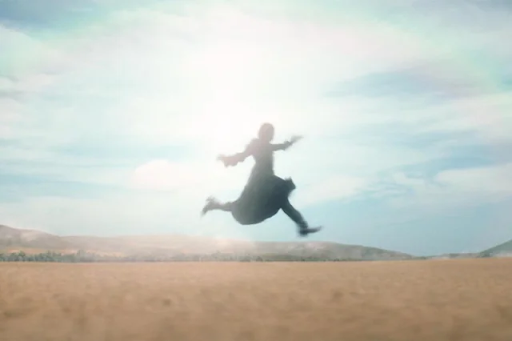
One of the few moments when we see Elphaba running, dancing, singing, free, and fully herself. (Screenshot from film)
AVA: I think it all works together so well, like you said, Samah. Even in the lyrics I can appreciate the liminal spaces of longing and resistance. My favorite song is “The Wizard and I,” where Elphaba finds her first moments defying gravity (somewhere still under the rainbow) as she sings. It’s the prefiguring of flight, childlike, still joyful, surprising, effervescent, and filled with hope and possibility. It reminds me of the folktales of flying Africans, retaining magic and keeping free-dom on their minds, despite the horrors imposed on them.
And I think it’s in those moments where I’m most confident in her refusal. From the beginning, even as she enjoys the rush and thrill of possibility with Madame Morrible’s affirmations, her cry in “The Wizard and I” is a ballad still deeply rooted in her sense of self: “And one day he’ll say to me, Elphaba / A girl who is so superior / Shouldn't a girl who's so good inside / Have a matching exterior? / And since folks here to an absurd degree / Seem fixated on your verdigris / Would it be alright by you / If I de-greenify you?"/ And though, of course, that's not important to me / ‘Alright, why not?’ I'll reply / Oh, what a pair we'll be / The Wizard and I.”
SC: I have to add that there’s a spectacular visual which accompanies that moment underscoring what you’ve named here, AVA. As Elphie is wandering the Shiz campus throughout the song, she comes across an open terrace. A mobile of colorful glass shards hangs above her as she thinks through that hypothetical conversation with the wizard. Because this is still early in the film, Elphie still very much has her guard up in an effort to project strength and indifference to people’s callousness (“Of course, that’s not important to me”). But Erivo’s voice (and Chu’s direction) are a portal into a different dimension mid-number: she wavers on the words “degreenify you” as the colored glass above her reflects light in multiple directions. When the red shines atop Elphaba’s green skin, it neutralizes into a deep brown. For a few seconds, we glimpse Erivo as she is and Elphie as she would be. It’s an arresting, puncturing moment between that world and ours, and a reminder that they’re not different worlds at all.
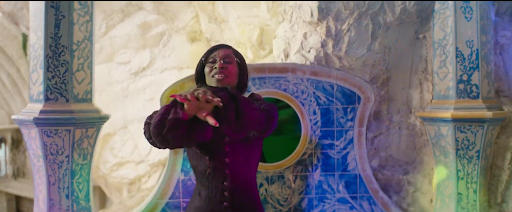
Elphaba sings on the terrace of Shiz University as a glass mobile above reflects different colors across the surfaces and her green skin; she briefly transforms into the version of herself she has long wished for. (Screenshot from film)
AVA: This is so important—beyond the most brilliant use of the word ‘verdigris’ that I know of, particularly in song—because when Elphaba finally does get to meet the Wizard, she is at first surprised that his miniature of her in this great big old world is still green. Surely everyone wants her green to disappear, even in the Emerald City, right? And I think this is the moment where Elphaba realizes that someone else in her world does not see her green as pathology, as something to be immediately fixed or changed. It’s a moment of affirmation, brief and fleeting, that the deep knowing that Elphaba has of her own sense of purpose and justice, is made all the more precise because of her experiences as green, not in spite of it.
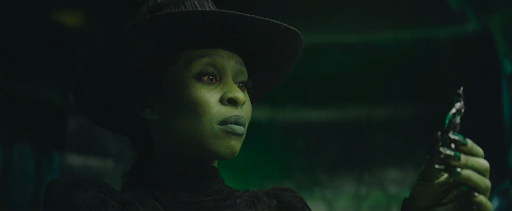
Elphaba gazes at the miniature figurine of herself handed to her by the Wizard and considers his invitation to join him as an advisor in the Emerald City (Screenshot from film)
So when Elphaba finally, fully, realizes her magic and takes flight, it feels ancestral. Like remembering a place you’ve never been. Perhaps it was the supernatural expansion of an old cloak into a wild and billowing sail, a wooden broom her ship, truth at the helm of her destiny. Or perhaps the lyrics that have always brought me to tears:
And if I’m flying solo
At least I’m flying free
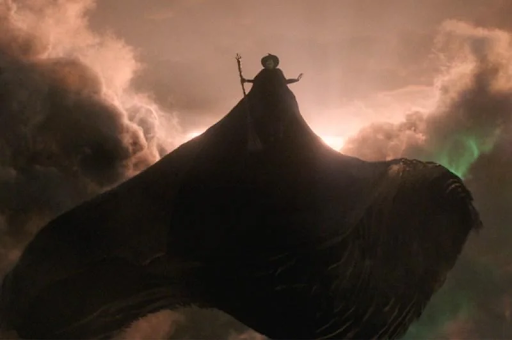
Elphaba fully inhabiting her power as her cloak expands; it is as if the screen itself cannot contain her. https://www.reddit.com/r/wickedmovie/comments/1h3tgcm/elphabas_cape/
AVA: So, speaking of green … one of the things that sticks with me, once we get to the second film Wicked: For Good, are the ironies of Glinda’s all-pink-everything. In a world that is completely green (except for a random fierce outfit from Madame Morrible), the propaganda for polarity is so strong that people no longer even see what to me seems obvious: Elphaba is more like them than anyone else! She is so green, shouldn’t she be relatable? The crown jewel of the Emerald City? It bothers me the entire time, as much as the wizard loves green! In one of the opening scenes, the juxtaposition of the banners leaves no space in between. It’s a strange yin and yang, Glinda is GOOD, upright, a beaming halo–so blonde, so pale, so thin. And the WICKED witch (dehumanized, and no longer remembered as Elphaba), upside down. Same font, same script, and no one can discern the similarities. The desperate commitment to binaries and manipulation leaves all justice suspended (until a misled mob turns into vigilantes, allegedly on behalf of Dorothy and avenging harm).
MKK: Ooooh, what you name about the banners—same font, same script, no space between, it caught me, too. Because the machinery of that binary doesn’t just dehumanize Elphaba, it also imprisons Glinda, in a way. And I think that’s another emotional cost represented in the film. Glinda is for sure complicit, but she’s also clearly … consumed by this fantasy. She’s organized her entire self around being the good one, the chosen one, the legible one, and yet by For Good you can see how hollow and airless that position has become for her. There is something suffocating about her pink. It feels congruous to the white-black binary (those are the other dominant colors in the banners), but the pink juxtaposed with green communicates a purity, a femininity, and innocence. The green, of course, its opposite. I’m not a color theorist. But where Elphaba’s green can also read as a mark of exclusion imposed from outside, Glinda’s pink starts to feel like a cage she decorated herself. The binary needs both of them to hold—it needs its villains as much as it needs a heroine—and what I started to feel was troubling was that neither woman actually gets to be fully herself within it. Elphaba is reduced to a symbol of wickedness, and Glinda is a symbol of goodness, a kind of model majority (as opposed to minority). These binaries diminish everyone…
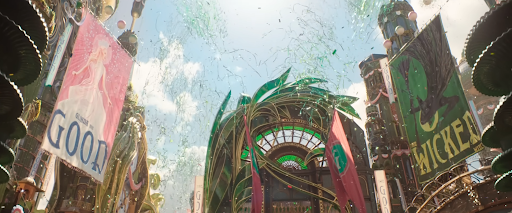
The two banners explicitly articulate the binary between Glinda and Elphaba in a way that feels superficial and performative.
AVA: Here’s another, more subtle point that broke my heart visually (Jon Chu, if you’re ever reading this, the juxtaposition of these shots were absolute brilliance). The contrast between Glinda descending the steps of her wedding as Elphaba descends the steps to find all of the incarcerated animals the Wizard has lied about was so poignant, as the contrast in lighting and Elphaba’s silhouette are a simultaneous revelation of the forced and so very false veneer of the excessively lit decor of the political marriage (though Glinda is there for a love she knows is not reciprocal). Both have been so grievously deceived, but one has hoped that believing long enough would make a lie come true, and everyone somehow ends up heartbroken. The juxtaposition is stunning, and the tension of these parallel moments remind me of how, in so many slave dungeons (on coastlines across the African continent and the shores of the Americas), there would be a chapel located right above. I mean, liturgy has always been a vehicle we use to lie to ourselves, right? Especially to maintain a world where your goodness relies on the wicked? It’s a seduction we are facing in real time. And Elphaba had already said it best to Glinda: “You can’t leave, because you can’t resist this.”
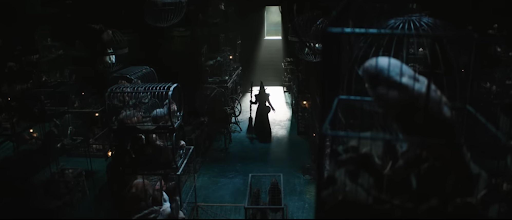
The dark figure of Elphaba walks down into the dungeon where the Wizard has been imprisoning animals, including her teacher Dr. Dillamond. Above ground, Glinda is similarly descending the steps to her ill-fated wedding. (Screenshot from film)
SC: She’s so deeply deluded by it too, that her response is akin to that iconic Meryl Streep line from The Devil Wears Prada: don’t be ridiculous Andrea, everybody wants this.
AVA: It hits hard. We think we know our boundaries, how far we’ll go—until we look and realize we’ve gone too far.
MKK: I’m going back to what Samah named at the beginning and thinking about how Wicked arrived in a crowded field of villain rehabilitation. But it does something none of those other narratives do—the Joker, Maleficent, Cruella—these are all essentially solitary origin stories. The anti-hero at the center is alone in their grievance, alone in their transformation, alone in whatever justice destruction they pursue in their single-minded endeavors. The moral reckoning, such as it is, happens in isolation. What Wicked does is something distinct, and compelling and complex—instead of loneliness being the story, it gives us a way to think about some interesting ethical questions about complicity, courage, about what we owe each other when the world is against us, what it means when someone makes a claim upon our lives, and how that can only be fully felt in the complexity of relationship.
SC: We are inherently bound to one another.
MKK: This is a story about two women who see each other clearly, fail each other painfully, and are changed by each other permanently. And I think that is a genuinely different genre move, not just tonally but structurally. The friendship isn’t a backdrop or subplot, it’s the moral architecture of the film. Which means the questions Wicked asks are more than “what made her wicked?” It’s harder and more tender to hold: What does it cost to stay close to someone the world has decided to destroy? And even more, what does it cost to look away?
SC: These are such jarring and profound questions. Honestly, I’ve been surprised that there hasn’t been more Discourse™ on it after the release of For Good. At the top of the second film, we get a another moonshot song from Glinda, “Thank Goodness.” It’s meant to be a mirror to “No One Mourns the Wicked” from the first film, where once more Grande walks that vocal tightrope of putting on a face for the world with brief moments of recognition that maybe she’s a prime reason they’re all in this mess. “But I couldn’t be happier / Simply couldn’t be happier / Well, not simply / ‘Cause getting your dreams / It’s strange, but it seems / A little, well, complicated.” Her epiphany, of course, is cut short just as she arrives at the precipice. Why? Because the alternative is, as AVA noted, irresistible. “With this perfect finale / The cheers and the ballyhoo /Who wouldn’t be happier?” The crowds, on cue, heap adulatory praise: “We love you, Glinda, if we may be so frank!”
MKK: A moment where the tides seem to turn, or perhaps it’s a reminder of the ebb and flow of the masses' attention and adoration of these two figures, the roles (both theatrically/performatively and socially) they play in this society. Especially, this egging on of Glinda, solidifies the necessity for her to also play a certain role by accepting this position. While this is a contrast to Elphaba, in some ways, it seems the people/crowds need both Glinda and Elphaba.
SC: Like “No One Mourns the Wicked,” Munchkins interject throughout what is mostly Glinda’s number. This time, they come in the form of Munchkins feeding the rumor mill about Elphaba’s goings-on: “I hear some rebel animals / Are giving her food and shelter / I hear her soul is so unclean / Pure water can melt her / (Fiyero interjects) What? / Melt her / Please, somebody go and melt her!”
This is more than just a cheeky reference to the Wicked Witch’s demise in the 1939 Wizard of Oz. Throughout both Wicked movies, we see and hear references to Elphaba and water (Morrible, in another instance, quickly grabs an umbrella for Elphaba when it starts to rain—“mustn’t let you get wet”—as Glinda scurries off so her minions can provide her cover). We are meant to understand that the whole water = instant death idea is just a silly rumor.
AVA: The lyrics just dance around all of the religious intimation of baptismal water and holy water here, but of course, not that there is any sense of transformation extended to Elphaba. They might as well be screaming “Off with her head!” They literally want her to have a permanent, fatal meltdown!
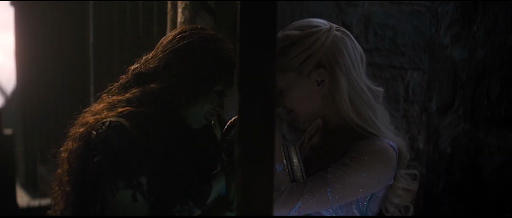
The two friends bid each other farewell (for good) on either side of a wooden door in Fiyero’s castle, knowing they’ll never see each other again. (Screenshot from film)
SC: Right! What is arguably the culminating scene of the second film sees the two friends on either side of a craggy wooden door in Fiyero’s castle, both heartbroken and positive in their own ways that they will never see one another again. Elphaba knows she must leave Oz altogether if she is to survive; there is no redeeming narrative arc for her in this world of “harsh binaries,” as you both so eloquently put it before. “Let all Oz be agreed / I’m Wicked through and through” she bellows just moments before (during the best song in For Good, the barn-burning “No Good Deed”). But Glinda is heartbroken because she is sure Elphaba is going to die. In this unfair, devastating moment Elphaba must manage her feelings in addition to Glinda’s. The plan can’t work, after all, if Glinda knows the truth. The knife twist for me is that Glinda’s fantasy, built over the course of two movies, extends even to this most critical, final interaction with her best friend, and she still won’t see the world as it is. These two women shared their deepest secrets, dreams, and pains with one another. They stood together as it started to rain and watched each other get wet! Why would she believe Elphie is dead when Dorothy throws that bucket of water?Because the alternative is even more unfathomable: in a world where Elphaba is rehabilitated and lives, the equivalent of reparations have to take place in Oz. It’s a white supremacist nightmare. So Elphaba doesn’t get to live in Glinda’s world of after - the fantasy does. It’s a stark, destructive point for the film to hinge upon.
AVA: What happens when you try to tell an entire society that its history is built on a lie? Glinda, even with her newfound backbone, is also not ready to be a martyr. She needs Elphie to be dead, lest Oz turn against all witches of every kind. And this is always the political compromise, isn’t it? That one can do more work from inside a broken system, than from refusing to participate? bell hooks wrote that, “The heart of justice is truth telling, seeing ourselves and the world the way it is rather than the way we want it to be.” How deeply we misunderstand that we behold as much beauty as we do pain if we truly look into the mirrors of our worlds.
SC: Wow, that might need to be the final word on this. Thank you, once again, for an illuminating conversation on religion at the movies. Until next time!