Procreation Stories
Pamela E. Klassen
April 13, 2026
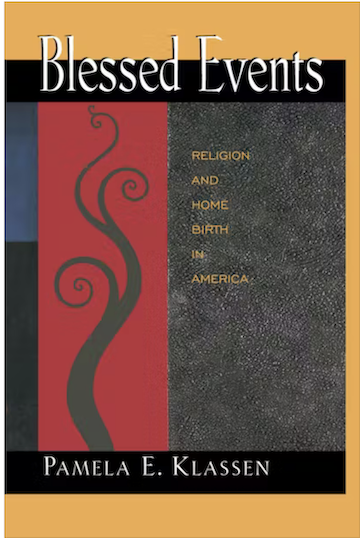
My second book, Blessed Events: Religion and Home Birth in America (Princeton 2001), remains my publication most likely to prompt intimate testimonials and bracing conversations—everyone has a birth story of some sort. Two of my favorite responses came from women with professional expertise. A couple of years after it was published, I received a letter of thanks from a British midwife, expressing her gratitude for my depiction of home birth as a site of women’s ethical reflection in a way that rang true to her own experience. Over coffee in a café a few years later, a religion colleague for whom I have great respect told me that she had found it helpful to recall the chapter on “sliding between pain and pleasure” while birthing her own child. That my book spoke to these women in their different kinds of labor was for me the best of all possible reviews.
More recently, when describing my research interests to a new colleague, my brief mention of Blessed Events prompted her to share a very personal narrative, both harrowing and witty, of her own experience of childbirth in a hospital many years ago. Once again, I found myself entering the delicate—and sometimes fraught—exchange of birth stories. When I revealed that I had given birth to my three children at home, my conversation partner expressed shock: “But how did you have the confidence that nothing would go wrong?” It was a good question and made me pause. Where did my confidence come from all those years ago? Was confidence the right word for what led me to that choice? I replied that I had felt well cared for and that I had trusted my body. It was not so much that I knew that nothing would “go wrong,” but that with the support and expertise of my midwife I would let the process of childbirth unfold, surrounded by my family and friends.
Published twenty-five years ago as a book that took seriously women’s experiences and stories of giving birth as grounds for theorizing the workings of religion and spirituality in America, the argument of Blessed Events seems as relevant today as it was then: to understand the politics and pull of religion and spirituality in the United States, cultures of childbirth are a generative place to begin. The home birth movement grew out of a mix of feminist critiques of the patriarchal overreach of biomedicine and the growth of conservative or traditionalist communities that sought freedom from state-regulated institutions, including hospitals. For both feminist and traditionalist home-birthers, I argued, discourses of religion and spirituality were key to the ways they constructed authoritative knowledge in the face of medical and legal opponents.
Taking this on as a dissertation topic in the early days of the “ethnographic turn” in the study of religion, I often had to answer the question of just what was “religious” about childbirth. Listening to and gathering women’s home birth stories from across three northeastern states brought me a variety of answers as their “procreation stories” conveyed diverse gendered visions of what was “natural” and what was “spiritual” about the birthing body. The ideological and religious diversity that characterized this marginal movement provided a more plainly denominational answer: the forty-five women I interviewed came from Amish, conservative Pentecostal, Latin Rite Catholic, Roman Catholic, Orthodox Jewish, Reconstructionist Jewish, Christian Science, United Methodist, Seventh-Day Adventist, feminist spirituality, and many other communities.
To analyze their narratives, I cast my net widely, drawing from poets, including Sharon Olds, from theorists of religion and gender such as Talal Asad and Judith Butler, from feminist anthropologists of reproduction, especially Emily Martin and Rayna Rapp, and from historians of women, such as Carolyn Walker Bynum. In the study of religion, the work of feminist scholars including Nancy Jay, Marie Griffith, Cynthia Eller, and Susan Sered was most helpful to me, as I argued for childbirth as an embodied practice where ethical and religious subjects are not only born, but also made.
The politics of childbirth and the accessibility of reproductive health care have changed in many ways since 2001. On the one hand, access to midwifery care and home birth have become more widespread. For a brief time, thanks to the Affordable Care Act, more US women had access to state-funded health care plans that paid for reproductive care, including contraception (until arguments undergirded by appeals to religious freedom jeopardized this access). On the other hand, federal and state surveillance of pregnant people and of reproductive health professionals has increased dramatically; new laws thwarting access to contraception and abortion now inflict coerced childbirth on many. The irony, perhaps, is that reproductive coercion is on the rise at the same time as movements for health “freedom,” such as anti-vaccination groups, the leaders of which have now ascended to run federal government health agencies.
When I wrote Blessed Events, I had a certain hope that the diversity of women who made up the home birth movement signaled possibilities for solidarity in the face of religious and political polarization. I still think that the vulnerability and power of childbirth can sometimes draw people together in ways that surprise them, but I am not so sure of the terrain of solidarity. Childbirth, as a cultured practice, is open to maneuvers of many kinds. For example, a recent Guardian podcast on the “Free Birth Society” argues that the power of social media amplifies and monetizes childbirth advocacy precisely through evoking polarization. A collaboration between two women birth activists, one from Canada and the other from the U.S., the Free Birth Society urges women to give birth with no medical care in attendance, warning women against not only obstetricians but also midwives if they want to achieve a “sovereign birth” imbued with “sacred power.” Not a new idea, unattended birth has had several proponents over the years, including those from traditionalist Catholic and New Age perspectives, which I detail in Blessed Events. These earlier free birth advocates, however, spread their views through self-published books and pamphlets sent in the mail, which limited the breadth of their networks when compared to the quick mediation of Facebook groups and podcasts.
Women will keep birthing babies (they will!) and the changing meanings of birth will always be worth careful study. Taking the chance to re-read my book twenty-five years later, I find myself especially grateful to the forty-five women who opened their homes to me, narrating their births with honesty and eloquence. I am also grateful to my younger self for summoning the confidence to undertake those many journeys, often in the company of my baby, to unfamiliar places where I listened to strangers, trusting that what I learned, distilled through the cooperative work of scholarship and the creativity of writing, could become a book that shed light on “American religion.”