
On the Convergence of History and Cultural Anthropology
April 16, 2026
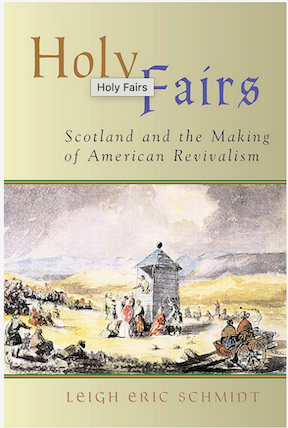
In 1987, the year I first went on the job market, our field’s very own Mark Silk wrote an impressive feature for the New York Times on “The Hot History Department.” Recounting the convergence of history and cultural anthropology at Princeton over the previous decade, embodied in the collaboration of Clifford Geertz and Robert Darnton, Silk’s piece captured the heady atmosphere surrounding this new “ethnographic history” in the early-to-mid-1980s—at least at Princeton. It was the kind of setting in which a graduate student could hear Peter Brown ask Carlo Ginzburg a gnomic, four-word question about a sixteenth-century carnival and feel bedazzled: “Who cleaned up, Carlo?” On the American side, wannabes like me turned especially to Rhys Isaac, also associated with Princeton’s Shelby Cullom Davis Center, whose The Transformation of Virginia, 1740-1790 had won a Pulitzer Prize in 1983. The book ended oddly for a tome with such literary accolades—with an arcane “Discourse on the Method” that explained how you too could become this new and increasingly “hot” thing, a marriage broker for history and anthropology.
I had all but memorized Isaac’s discourse, had sunk deeply into Geertz’s thick description, could spout off about charivaris and cockfights, and was hopeful that my dissertation on “Holy Fairs” was a fine example of all this newness. As I entered the job market, I felt ready to take the show on the road. Over dinner at one of my first campus interviews, I was talking about Isaac’s dramaturgical method, his imagining of ethnographic history, and how that larger enterprise was reorienting religious history (in terms of ritual, performance, popular culture, and the “mentalities” of laypeople). I remember a senior historian of early modern Europe who looked dubious, and he made what I took to be a knowing wink to one of his colleagues that seemed to convey: “We’ve heard it all before. You and everyone else. Fashions come, fashions go, and it will be good when this one expires.” Maybe it wasn’t an insider wink among colleagues, of course; maybe that construal was only an anxious projection of exposure—it was easy for me, then and now, to get bogged down when parsing the social cues of “interaction rituals.” Winks upon winks, after all. Still, that early job interview, outside the Princeton bubble, was a bit of an awakening: not everyone wanted this marriage to succeed, and some thought it already a failure.
Soon enough, I stopped talking about Geertz and Isaac—or, at least, mostly stopped talking about them—and moved on to other things (holidays and the consumer culture, religion and the senses, Ida Craddock, atheism, etc.). Even so, I never deserted the marriage of history and ethnography. I re-introduced Holy Fairs in a second edition in 2001 with some of the “new” questions about a cultural history of the study of religion that had informed Hearing Things (2002), but I saw no need to qualify my earlier enthusiasm for pursuing (in Darnton’s phrasing) “history in the ethnographic grain.” Indeed, at this late point, I see it as a kind of through-line from age 22 to 64, the spine of the play.
I couldn’t have written about Easter parades, ventriloquist shows, Sarah Farmer’s Greenacre, the Church of Yoga, or secular funerals without the performative, action-oriented, episode-driven, ground-level, meaning-unpacking, microscopic propensities of the ethnographic history that I first encountered as a PhD student. Obviously, then as now, we very much need bigger histories—of, say, nations, empires, revolutions—as well as more abstractly theoretical accounts—of, say, power, performativity, materiality—but Geertz’s interpretive approach promised to get to such “grand realities” through (as he remarked wryly) “exceedingly extended acquaintances with extremely small matters.” It is all in the execution, of course, but, done well, such “ethnographic miniatures” still make for good history.
I also remain drawn to the theatrical emphases in this vein of historical work—all the attention paid to staging, role-playing, script, gesture, costume, scenes, props, masking, and dance, the whole “dramaturgical kit” of social and religious life, as Isaac called it. I took a detour along the way into genealogies of modern constructions of religion, particularly “mysticism” and “spirituality,” but I have come back around to bits of that material now with a more dramaturgical eye. How Whitman redefines religion and allied categories still interests me, but how Whitman performs the combined role of poet and revelator may well intrigue me more. I look at H. P. Blavatsky, Albert Leighton Rawson, and H. Spencer Lewis uninterested in questions about authenticity and charlatanry and see the artfulness with which they dressed up their ancient wisdom. The same would go for the esoteric magus Frithjof Schuon. The fine points of his perennial philosophy notwithstanding, I find my curiosity piqued instead by how elaborately he played Indian after relocating from Lausanne, Switzerland, to Bloomington, Indiana. Whatever else it is, modern “spirituality” is a theater for exoticized and often eroticized role-playing. It is performance art.
That last point—about performance art—came into crisp focus for me as I went overboard a couple of years ago in my fascination with Reverend Billy and the Church of Stop Shopping. Led by William Talen and Savitri D and based in New York City, the troupe has garnered substantial scholarly and journalistic attention over the last three decades as spectacular critics of consumer culture and neoliberal capitalism. (In this regard, I recommend especially the new ethnography by George González, The Church of Stop Shopping and Religious Activism.) Questions of authenticity and sincerity, the real and the fake, are all part of Talen’s show—but only a small part of it. To watch Reverend Billy exorcize a cash register at Starbucks, process with a crucified Mickey Mouse, lead a prayer in a hot pink suit at Earth Church, or join the choir in a carnival of Sanctified Oddness is to be confronted with a religion of sheer theatricality, dramaturgy not as metaphor but as practice. It is also to watch a street performance, an ethnographic miniature, illumine a colossal history of global capitalism as well as the small-scale arts of resistance used (often forlornly) to contest that power.
Closing in now on the golden anniversary of this wizened marriage of history and cultural anthropology, I still see the attractions of the ethnographic history that this conjoining produced. In generationally distinct ways, it seems to me that partnership very much continues to be fruitful for the study of American religion. These disciplinary convergences, now unremarkable, flourish without the trendiness that some scholars feared, already in the mid-1980s, was wrecking the relationship. If everyone began studying carnivals and cat massacres, where was the edge? Nonetheless, the marriage survived, and, as long as the humanities live to tell the tale, the vows at this point appear recurrently renewable.